Setting up the Perioperative Environment for Minimally Invasive Procedures
Insufflation and Pneumoperitoneum
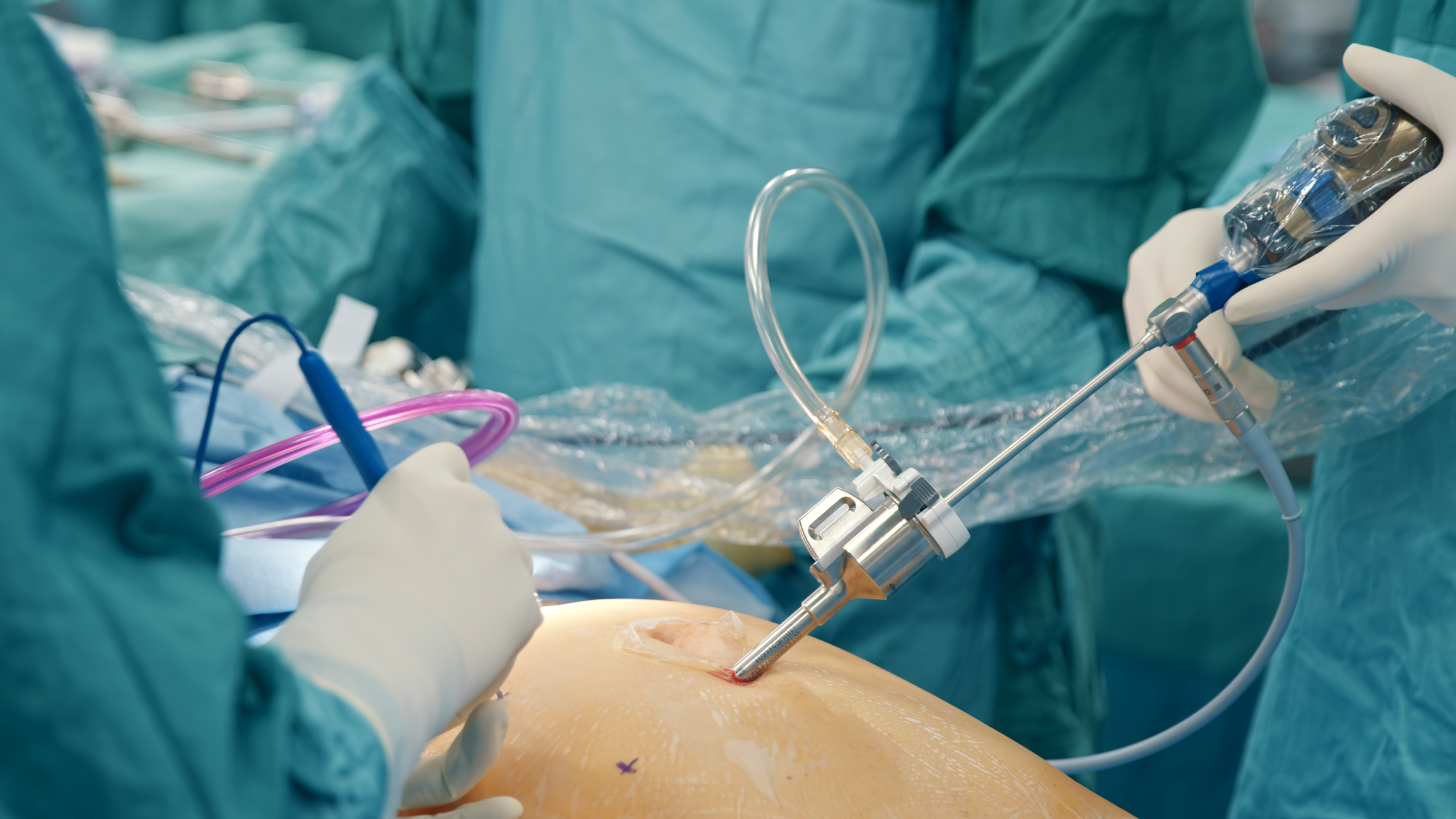
For the surgeon to visualize organs and tissue within the abdominal cavity, a pneumoperitoneum must be created. The steps for this are as follows:
Step 1: A small incision is made near the umbilicus and a Veress needle is inserted into the abdomen.
- To prevent injury to internal organs, the surgeon pulls up abdominal tissue while inserting the Veress needle.
- To decrease the risk of perforating the bladder, patients are asked to void immediately prior to surgery, or a catheter can be inserted to empty the bladder.
- Patients are placed into the Trendelenburg position to allow all abdominal organs to shift out of the way.
Step 2: The surgeon passes the needle at a 45-degree angle as it enters. The proper placement is confirmed by connecting a syringe with saline and ensuring no resistance, as well as negative bowel and blood return on aspiration.
Step 3: Once the placement is confirmed, the surgeon connects the insufflation tubing, and the circulating nurse turns on the CO2 gas at a low flow rate.
Why use CO2 gas?
- It is not combustible.
- It can be absorbed by the body at high volumes without negative consequences.
- It is inexpensive.
Step 4: If the cavity fills without any issues, the circulating nurse is then asked to turn the flow rate up to higher volumes until the intrabdominal pressure reaches 14-16mm (about 0.63 in) Hg. The flow rate should ideally be at least 9L/min to help maintain the pressure despite gas leaks from instrument changing, smoke evacuation, or other leaks.
(Ball, 2019)
Risks of Pneumoperitoneum
The excess pressure from CO2
- Can cause CO2 to diffuse into the blood which can cause hypercarbia. The anesthetist monitors the end-tidal CO2 closely during laparoscopic cases to detect increased levels of CO2.
- Can also increase a patient’s risk of aspirating stomach contents as the pressure can cause gastric regurgitation.
- Reduces intrathoracic space which can impact a patient’s respiratory effort and decrease cardiac output.
- Can cause irritation of the phrenic nerve which can lead to severe postoperative pain in the shoulder and neck.
What can be done to reduce excess pressure from CO2?
- Ensure that as much residual CO2 gas is removed at the end of the case before trocars are removed.
- When possible, use insufflators or smoke evacuator systems that can monitor and alert to high pressures, or can automatically vent excess CO2 gases.
Preventing Gas Contamination
To prevent CO2 gas tank contaminants from entering a patient, all CO2 insufflation tubing must incorporate a single-use disposable filter. This filter is hydrophobic and has two ways of preventing contamination:
- Prevents microorganisms coming from the patient from entering the CO2 tank, and
- Prevents contaminants such as chromium particles from crossing from the CO2 tank into the patient.
(Ball, 2019)