Legalities for Perioperative Nurses
Legal challenges to nurses used to be rare but due to the consumer movement, there is an increasing trend for the public to seek damages. The nursing profession must be more aware of its legal responsibilities. Also, the transfer of medical functions to nursing practice and the tremendous growth of knowledge in healthcare and technology has increased the scope of nursing practice and added considerable risk. Perioperative nurses are increasingly held responsible for aspects of practice that were not considered issues in the past, and they can be named as witnesses or defendants in legal cases.
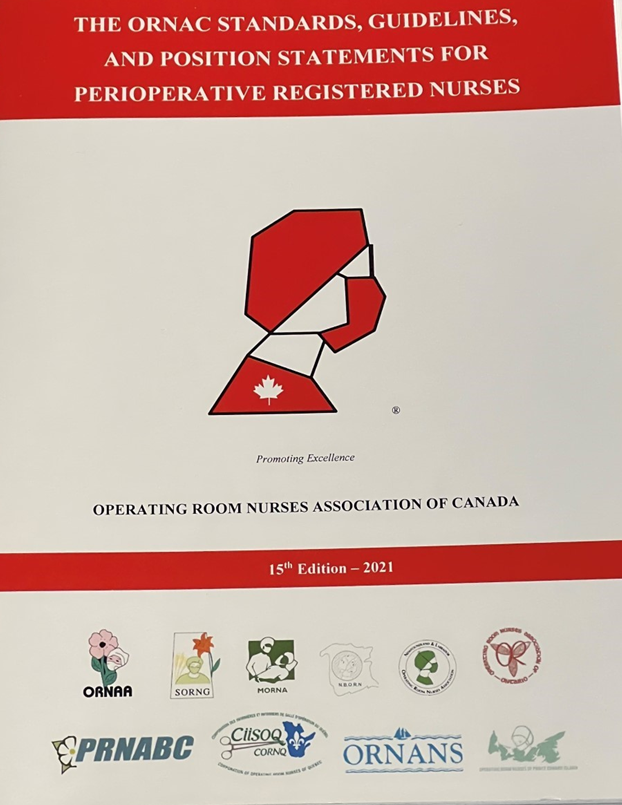
Perioperative Nursing Standards of Practice and Care
Perioperative nurses have a personal and professional responsibility to achieve and maintain a level of competence and standard of practice set out by the governing body and promote the public’s confidence in the profession.
Standard of Care is an appropriate professional level of conduct and diligent performance practiced by most nursing peers in the same or similar circumstances. Liability can exist when care falls below standard. Professional accountability relates to the time of the incident; so, if an incident occurred five years ago, the nurse is held to the standards that existed then.
In the Canadian perioperative specialty, actions and practice must be consistent with the Operating Room Nurses Association of Canada (ORNAC) recommended standards of practice.
(Keatings & Adams, 2020; ORNAC, 2021)
Surgical Conscience
Surgical conscience refers to the guiding light of honesty and moral fortitude for perioperative nurses. These qualities assure acceptance of responsibility for actions and corrective interventions, and apologies for errors at the point of care. For example, a perioperative nurse accidentally breaks the aseptic technique and immediately intervenes to correct the situation despite the disruption or repercussions it may cause for the surgical procedure. The correction prevents patient harm and engenders patient trust.
Perioperative Liability
A perioperative team works to achieve successful results; however, human error may still occur. Although institutions have policies and procedures in place that outline tasks performance, common errors can include:
- Incorrect patient identification.
- Consent not informed.
- Performing a wrong surgical procedure, usually at the wrong site.
- Retention of a foreign body in the incision.
- Burns from energy-producing surgical devices, such as ESUs (Electrosurgical Units) or lasers.
- Positioning errors or falls that lead to patient injury. For example, brachial plexus damage by overextending the arms.
- Misidentification or misplacement of specimens.
- Incorrect medication administration.
- Secondary harm due to defective equipment or instrumentation.
- Harm due to a major break in sterile technique.
- Failure to make corrective actions based on sentinel events and/or never events (see Module 4).
(Clendinneng, 2020)

Perioperative negligence is an act or omission that does not meet standards of care. When care is breached, the nurse may be liable if the patient incurs emotional or physical damages that are directly attributable to the negligent act.
The perioperative nurse would be liable if they improperly positioned and hyper-extended the patient’s arms to over 90° for the surgery and this resulted in brachial plexus nerve damage. In this case, nerve damage would have been a direct result of substandard care.
Advance Directives
Advance directives are stated and signed by a person who is in full mental capacity. The surgical team must collaborate to ensure the patient’s wishes are upheld during surgery when the patient’s condition indicates the necessity to apply advance directives. These directives are legally binding under circumstances when the patient loses the capacity to consent to treatment. Sometimes another person with a durable power of attorney acting as the patient’s decision-maker must be consulted.
Coroner’s Inquest
Coroners investigate suspicious or unexplained deaths. In the operating room, the coroner investigates specific criteria about a patient death that occurs during an operative procedure, while under anesthesia, or within a designated time after the operation or anesthesia.
The coroner must be called immediately after the death and according to institutional policy.
The time of death is established by the anesthetist and surgeon and recorded on the chart. Invasive monitoring lines such as IVs, arterial lines, and ET tubes, must remain in situ (in place) and all items must be left untouched in the OR until after the coroner reviews the body and gives the approval to proceed.
Collecting Evidence
Nurses must handle potential evidence according to hospital protocol, and factually document events prior to and at the time of death. You will learn more about this when you complete the module on specimens in course 2.