Endoscopic Instrumentation
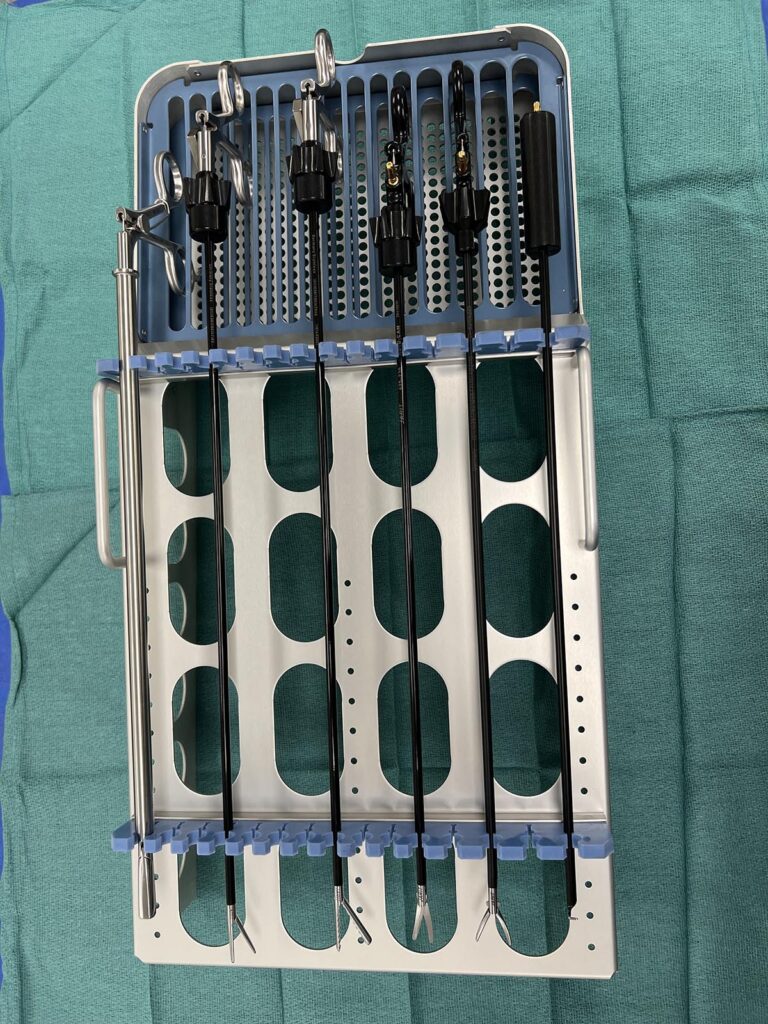
Endoscopic instrumentation has similar components and aspects to surgical instruments used for open procedures. There are instruments designed for dissecting, clamping, suturing/stapling, and retracting. However, laparoscopic instruments have a fine working tip, a long shaft, and a handle at the distal end for the surgical team to hold and manipulate. These can be disassembled to change the functionality of an instrument and allow for cleaning and decontamination.
Further information will be presented in module three when you learn about surgical instrumentation.
(Ball, 2019)
Trocar Systems
Trocars are specialized endoscopic instruments that allow for access to a closed cavity when no natural orifice exists. The trocar system then provides access to a cavity for endoscopic instrumentation to be safely inserted and removed with minimal damage to the surrounding tissue. Depending on the procedure, more trocars may be needed to provide access for additional instruments at varying angles.
Trocars come in varying lengths. The size of a trocar is dependent on the patient’s size. For example, pediatric patients require small trocars while bariatric patients require longer length sheaths to pass adipose tissue.
Trocars come in varying diameters. The diameter is dependent on the surgical procedure being performed.
Trocars can be sharp or dull with a blunt tip. Blunt tip trocars are often used in laparoscopy when an open approach is made for the first trocar through a paraumbilical incision under direct visualization. In these cases, a sharp trocar is not required because a small incision has been made. This approach is often used in patients with a history of multiple surgeries, in patients with adhesions, and in pediatric patients.
The makeup of a trocar consists of the following components (select the + hotspots in the image to reveal information):
Trocars can be reusable or disposable:
- Reusable trocars must be inspected carefully, and the obturator tip requires frequent sharpening. The components of reusable trocars must be disassembled for cleaning and sterilization.
- Disposable trocars have the advantage of always being sharp. Manufacturers attempt to decrease waste by packaging multiple trocar sleeves with one obturator.
(Ball, 2019)
Endoscopic Surgery Requiring Extracorporeal Procedures
Some laparoscopic cases require extracorporeal procedures. This means the tissue undergoing surgery must be brought out of the cavity through a small hole to perform the procedure outside the body. In these cases, a larger diameter trocar is used so the tissue can easily be brought extracorporeal.
(Ball, 2019)
Single Port Laparoscopic Surgery
Larger trocars can also be used to allow for single-incision laparoscopic surgery by adding on a single port platform as shown below. This allows multiple instruments to enter and be used in one port site.
(Ball, 2019)
Natural Orifice Transluminal Endoscopic Surgery
This is an evolving area of surgical advancement. Natural Orifice Transluminal Endoscopic Surgery (NOTES) is a procedure where an endoscope is passed through a natural orifice such as a mouth, urethra, or anus. The endoscope then can make an internal incision to perform surgery through the scope of a ‘scarless’ procedure.
Minimal Access Surgery Program
Natural orifice transluminal endoscopic surgery, or NOTES, is a form of scarless surgery performed through an internal incision behind the uterus…
Read Article
(Ball, 2019)
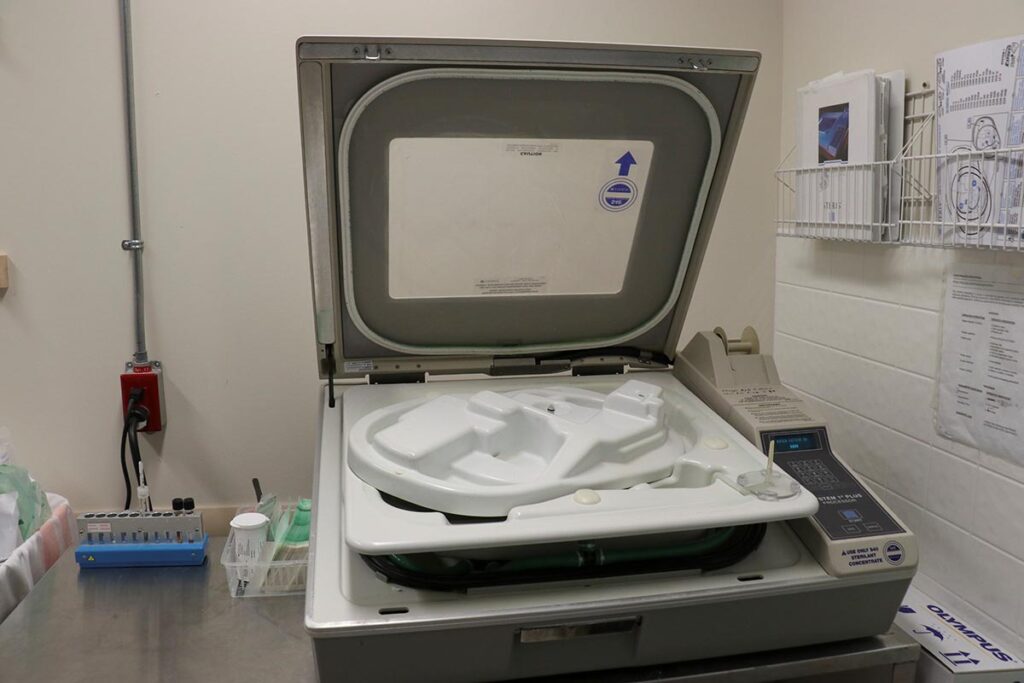
Care and Cleaning of Endoscopic Instrumentation
Again, this will be discussed further in the course; however, it is important to recognize that endoscopic instrumentation is very delicate and must be handled with care.
- These instruments have multiple channels, ports, crevices, and movable parts which must be thoroughly cleaned.
- Gross debris must be removed during the procedure.
- Thorough decontamination is necessary after each procedure.
- Enzymatic detergent is used to clean and flush.
- All scopes and instruments must be clean and free from all bioburdens.